
How RedyHire Uses Judge0 to Power Advanced Technical Assessments
By Abhishek Gupta
Introduction
RedyHire is an AI-powered hiring platform built to help teams hire with more speed, precision, and integrity. Across the platform, we combine resume screening, skill assessments, proctoring, and AI interviews to generate deeper candidate insight at every stage.
One of the hardest engineering problems in hiring, however, is not resume analysis or workflow automation. It is evaluating coding skill in a way that is reliable, scalable, and fair to both recruiters and candidates.
This is where Judge0 became an important part of our technical assessment stack.
The Assessment Problem We Needed to Solve
Technical hiring does not rely on just one type of coding question. Different roles and different interview stages need different formats, different evaluation depth, and different levels of realism.
At RedyHire, we support three broad coding experiences:
- Paper-style coding questions where the focus is logic, problem-solving, and code quality rather than syntax-perfect execution
- Standard coding questions with compile and run support for common programming languages
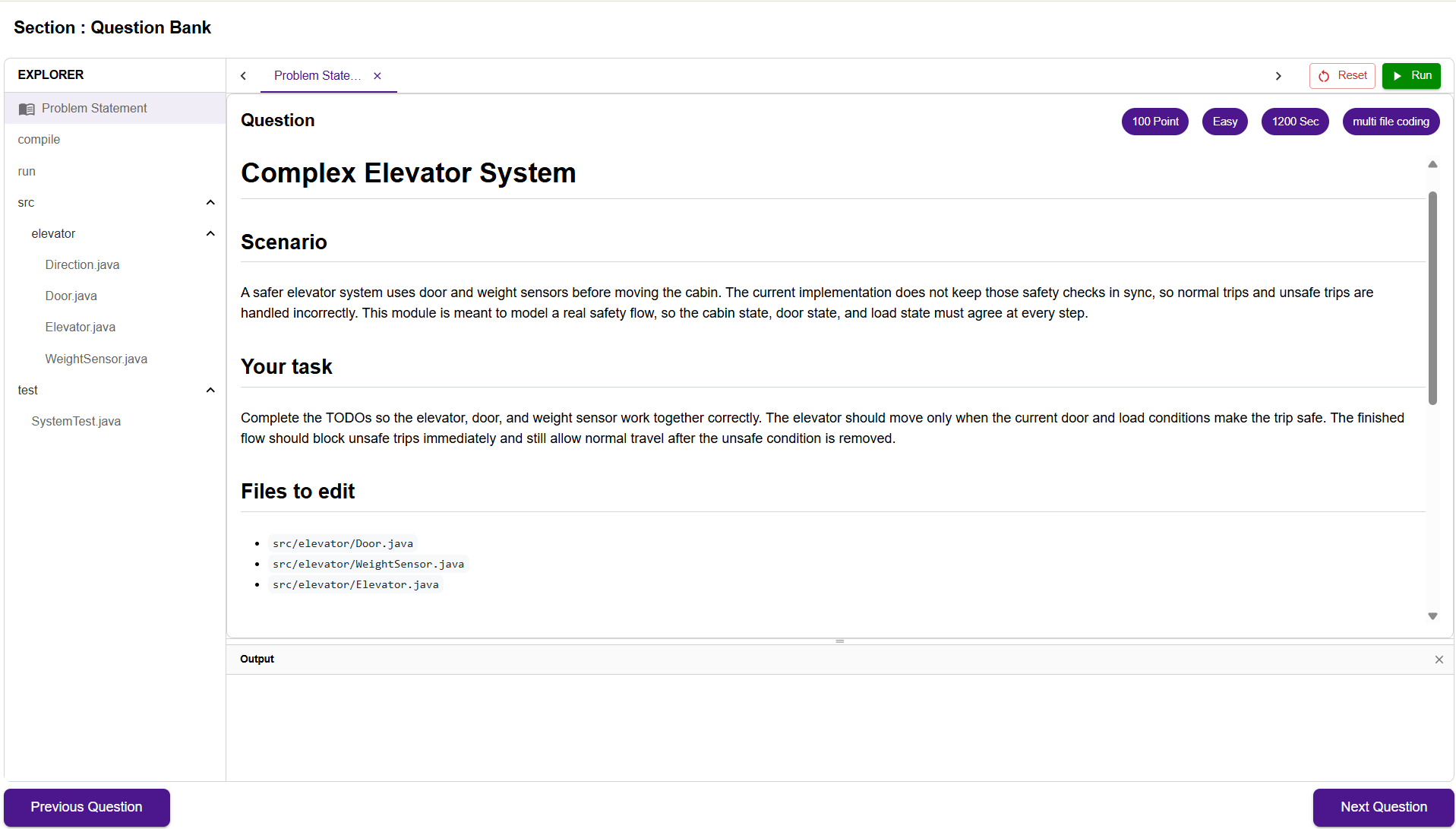
- Multi-file coding problems that resemble small project scenarios instead of isolated algorithm prompts
The challenge was not just rendering a code editor. The challenge was generating strong evaluation signal for recruiters while keeping the candidate experience smooth.
Where Our Earlier System Became a Bottleneck
In our earlier architecture, we relied on a self-hosted open-source code execution system written in Java. It helped us get moving initially, but over time it created two major bottlenecks.
1. Language and Execution Rigidity
As the platform evolved, adding new languages or supporting more advanced execution scenarios became increasingly expensive. Features such as SQL execution and broader compiler coverage demanded repeated custom engineering work.
This limited how quickly we could expand the types of technical assessments we wanted to offer.
2. Content Creation and Question Authoring Complexity
Execution was only one side of the problem. The second bottleneck was content generation.
To build strong technical assessments, we needed more than a place to run code. We needed a way to create fresh questions, define inputs and outputs cleanly, support hidden test cases, and extend the same logic across multiple languages.
This worked reasonably well for simple problems. But once we started pushing toward richer scenarios involving classes, structs, objects, and multi-file setups, the authoring and parsing burden grew sharply.
The result was predictable: execution complexity increased, content complexity increased, and both started slowing product progress.
Why Judge0 Was the Right Shift
Judge0 gave us a cleaner execution layer without forcing us to keep solving infrastructure problems that were no longer core to our product differentiation.
The biggest gains were immediate:
- broader out-of-the-box language support
- access to newer compiler versions
- simpler support for compile-and-run workflows
- the ability to introduce SQL execution without building it ourselves
This reduced the amount of custom engineering we had to spend on execution plumbing and let us focus more on assessment quality, candidate experience, and evaluation intelligence.
Beyond Single-File Coding Questions
Judge0 became especially valuable once we moved beyond standard single-file coding problems.
Single-File Execution
For algorithmic questions and debugging-focused exercises, Judge0's standard execution model gives us the foundation we need for fast, deterministic benchmarking.
This helps us evaluate:
- foundational problem-solving
- implementation quality
- debugging ability
- handling of common and edge-case inputs
Multi-File Execution
This is where things get more interesting.
With multi-file execution, we can create interview scenarios that feel closer to real development work. Instead of asking a candidate to write one function in isolation, we can place them inside a small codebase and ask them to fix a bug, complete a TODO, or reason about how multiple files interact.
That produces much stronger hiring signal than a narrow toy problem.
It lets recruiters see whether the candidate can:
- navigate an existing code structure
- understand context before changing code
- make targeted fixes instead of starting from scratch
- work through project-like constraints under interview conditions
What This Unlocks for RedyHire
Judge0 did not just improve code execution. It helped unlock a broader candidate evaluation model for us.
By pairing Judge0's runtime capabilities with RedyHire's evaluation layer, we can generate more useful recruiter-facing output instead of just pass-or-fail execution results.
That means we can build toward:
- richer technical question types
- stronger multi-language support
- more realistic coding interview formats
- better candidate benchmarking
- more context-aware technical evaluation
In other words, Judge0 handles the compile-and-run foundation, while RedyHire focuses on the intelligence built on top of it.
Infrastructure and Cost Benefits
There was also a meaningful infrastructure impact.
Our self-hosted setup required always-on AWS resources across multiple availability zones so that execution stayed instantly available, even when no candidate was actively taking an assessment.
By shifting to Judge0's on-demand model, we were able to reduce that persistent infrastructure overhead and avoid continuing to scale a system whose maintenance burden was growing faster than its strategic value.
That gave us a cleaner cost profile and reduced operational drag on the engineering team.
Looking Ahead
We are continuing to build more interactive and realistic technical assessment experiences at RedyHire. Judge0 remains an important execution backbone for that work, especially as we expand the kinds of coding scenarios candidates can encounter.
The more reliable and flexible the execution layer becomes, the more energy we can put into the parts that matter most to our customers:
- better technical evaluation quality
- more realistic interview experiences
- clearer recruiter insights
- faster assessment innovation
Judge0 helped remove a major bottleneck from our assessment stack. That has given us more room to invest in the product intelligence that actually improves hiring decisions.
Conclusion
Strong technical assessments are not just about running code. They are about generating trustworthy hiring signal, especially when proctoring and trust controls help teams rely on the result.
For RedyHire, Judge0 became a practical way to expand language support, unlock multi-file scenarios, reduce infrastructure overhead, and move faster on assessment innovation.
That shift lets us spend less time maintaining execution plumbing and more time building better technical hiring experiences.
About the Author
Abhishek Gupta wrote this post as part of RedyHire's ongoing engineering and product thinking around technical hiring, coding interviews, and scalable assessment systems.